
How V.D. Satheesan’s conviction, Gen Z appeal, and Nehruvian clarity reshaped Kerala politics – and what it means for God’s Own Country
By Ravisankar KV
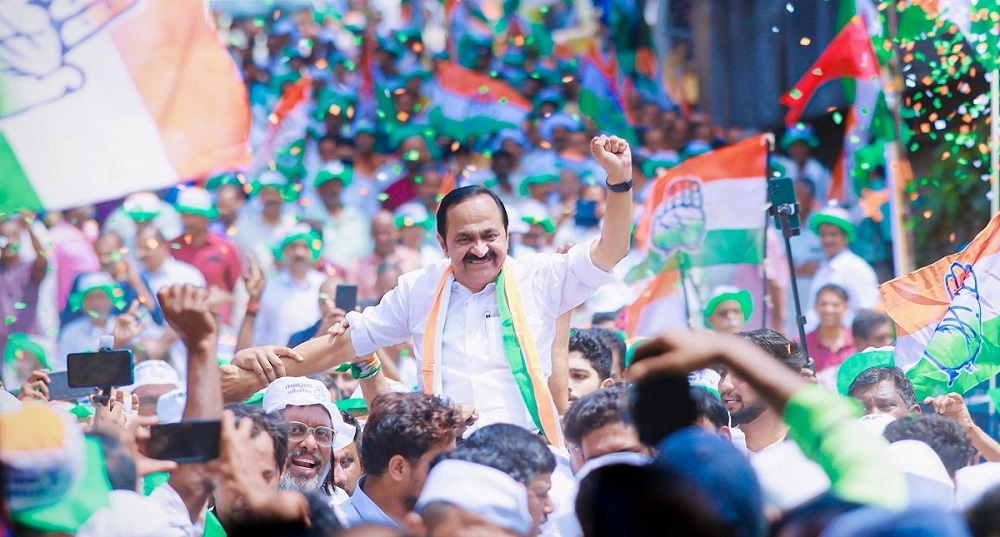
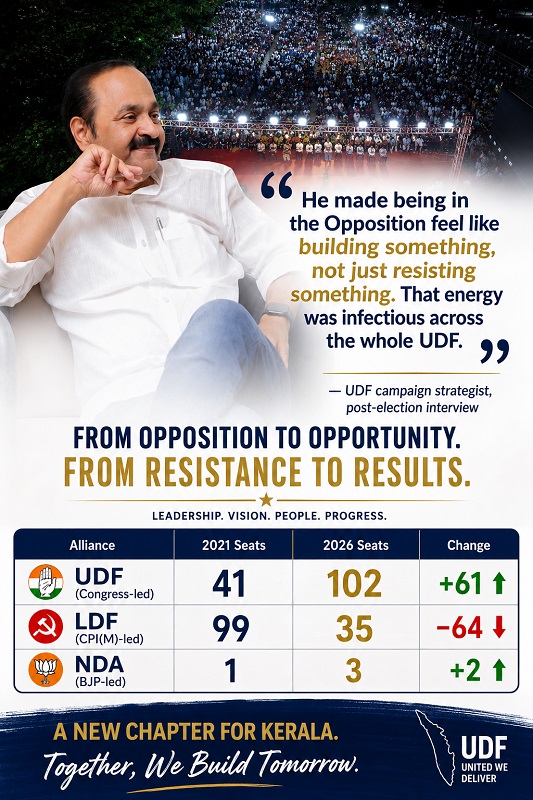
On the morning of May 4, 2026, as the first results trickled out of Kerala’s 140 Assembly constituencies, something remarkable was happening: seat after seat was painting itself in Congress blue – not in the coastal towns and cities where the United Democratic Front had long held sway, but in the inland Red Forts of Thrikkaripur, the Leftist heartlands of Taliparamba and Payyannur, and the paddy-field politics of Ambalappuzha. By the time the last result was declared, the scoreboard read 102–35 in the UDF’s favour – a landslide that most pollsters had missed, but one man had predicted with complete certainty, months before the votes were counted.
The Prediction That Wasn’t Bravado
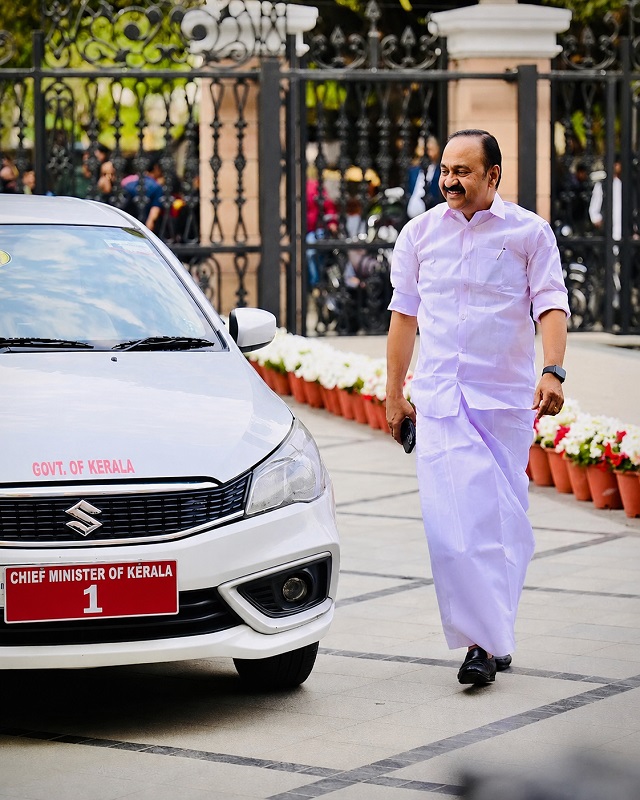
That man was Vadassery Damodaran Satheesan.
Now, ten days after that historic count, the AICC has named him Kerala’s Chief Minister-designate. For Brand Kerala Business Magazine – a publication dedicated to showcasing the promise and possibility of God’s Own Country on the national and global stage – this political moment is also an economic and developmental story. Because the man ascending to Cliff House is not merely a political victor. He is a generational signal: of a Kerala growing impatient with ideology untethered from delivery, hungry for a leadership that speaks in the language of evidence, transparency, and future-readiness.
This is the story of how V.D. Satheesan got here – and what his arrival means for Kerala’s next chapter.
It was somewhere in the middle of the campaign season, at a public meeting that drew a crowd larger than most analysts expected, that V.D. Satheesan looked into the cameras and said it plainly: the UDF would cross 100 seats. No hedging. No qualifier. One hundred seats, he said, in a 140-member house that the Left had held for a decade.
Political commentators were sceptical. The LDF had broken Kerala’s famed alternating-government pattern in 2021 for the first time. Chief Minister Pinarayi Vijayan had cultivated an image of administrative authority. The machinery of a government with deep institutional roots is notoriously difficult to dislodge. Even Satheesan’s own party colleagues whispered that 80 would be a fine result.
He won 102.
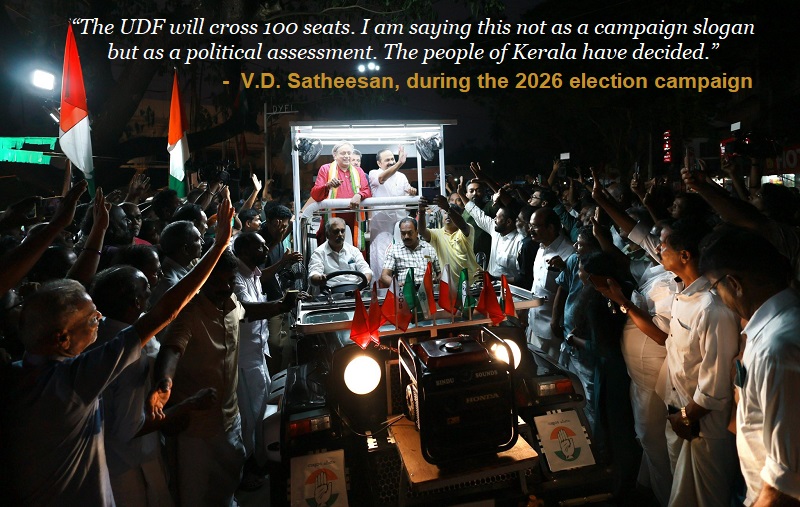
The prediction was not bravado. It was the output of a man who had spent five years reading Kerala’s political ground with the precision of a constitutional lawyer building a case – methodically, evidence by evidence, argument by argument. Satheesan had spent his years as Leader of the Opposition not merely opposing, but diagnosing: the state’s growing economic anxiety, the simmering public fatigue with what voters described as administrative arrogance, and – most crucially – the stirring of a generation of young Keralites who wanted their politics delivered differently.
That generation would become the decisive factor in May 2026. And they had found, in Satheesan, a leader they could follow.
The Gen Z Factor: A New Kerala Speaks
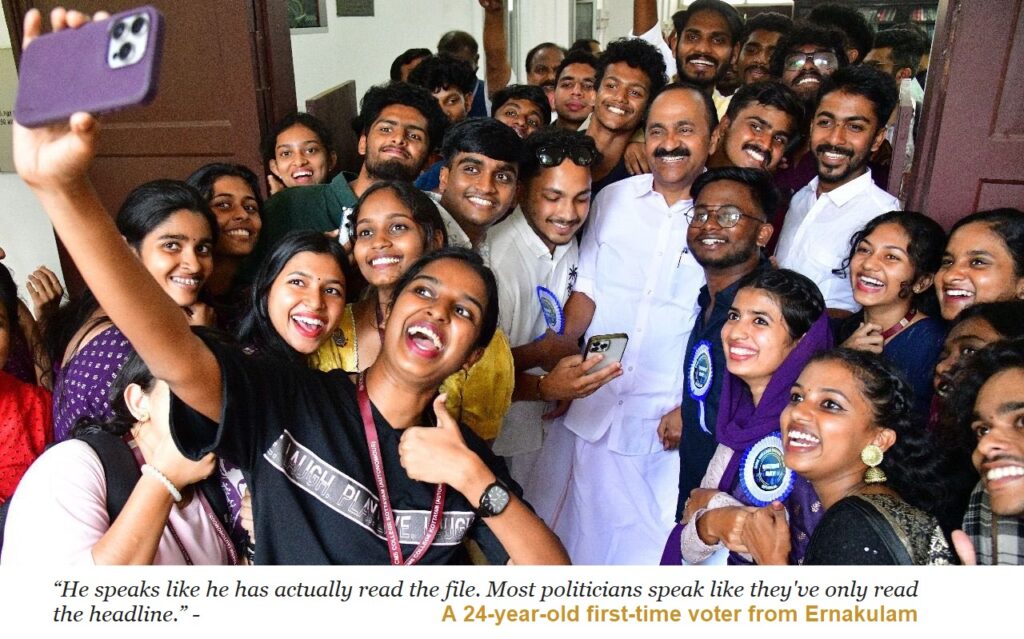
To understand why V.D. Satheesan resonated so powerfully with Kerala’s younger electorate, one must understand what Gen Z voters in Kerala actually want from politics – and how dramatically different that expectation is from the generation that preceded them.
Kerala’s young voters – the 18-to-30 cohort that turned out in numbers that surprised even seasoned booth managers – are arguably the most politically sophisticated young electorate in India. They are educated, digitally connected, globally aware, and deeply rooted in Kerala’s social consciousness. They consume political discourse through social media, YouTube debates, and WhatsApp circles with far greater critical scrutiny than their parents’ generation applied to campaign rallies.
What they found in Satheesan was, by their own accounts in post-election interactions, startlingly refreshing: a politician who didn’t talk down to them, who didn’t reduce complex governance questions to slogans, who cited data and court judgments in his speeches, and who was willing to hold a position even when it was unpopular.
Satheesan’s communication style – precise, argumentative, anchored in facts – resonated with a cohort trained by the internet to distrust vagueness. His press conferences routinely ran longer than any political operative would recommend, precisely because he took questions seriously, answered them in full, and occasionally corrected himself mid-answer when he felt he had been imprecise. For Gen Z voters accustomed to political doublespeak, this was almost disorienting in its directness.
The UDF’s campaign strategy also made a deliberate pivot toward this demographic. Nearly half of the newly elected UDF MLAs are young candidates – a stark generational contrast with the LDF’s more veteran-heavy ticket. The message was implicit but unmistakable: this coalition was offering itself as a vehicle for a newer Kerala, not just a change of government.
Social media data from the campaign period shows Satheesan consistently trending on Kerala Twitter and Instagram, with his Assembly speeches and press conference clips being shared and commented upon by younger users at rates that exceeded even national political figures. He wasn’t manufacturing a persona for the digital audience – he was simply being himself, and a digitally savvy generation recognised authenticity when they saw it.
The Nehruvian in the Room: Ideology as Clarity
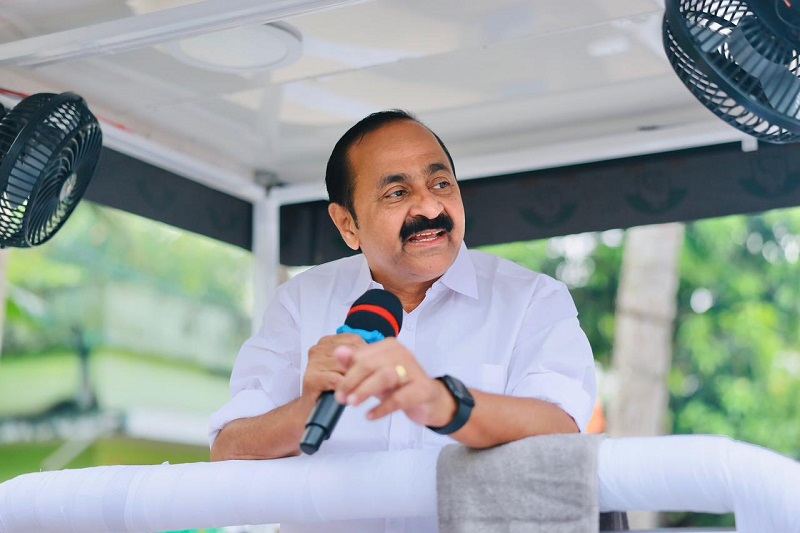
In a political era that prizes populism over principle and immediate optics over considered ideology, V.D. Satheesan occupies an unusual position: he is a politician whose ideology is legible.
Those who have followed his career closely describe his intellectual framework as firmly Nehruvian Socialist and democratic – an adherence to the founding Congress vision of a secular, plural, constitutionally governed republic with active state responsibility for social welfare and economic equity. This is not a fashionable position in 2026, in a national political landscape that has been reshaped by identity politics, economic nationalism, and personality cults of varying varieties. But in Kerala, which has always been a state that takes political ideas seriously, it proved to be a differentiating asset.
Satheesan’s secularism is not the defensive, apologetic secularism of a politician threading the needle between communities. It is the confident, constitutional secularism of a leader who genuinely believes that Kerala’s multi-religious, multi-caste society is its greatest strength – and that any political project that seeks to divide it along communal lines is not merely morally wrong but strategically foolish.
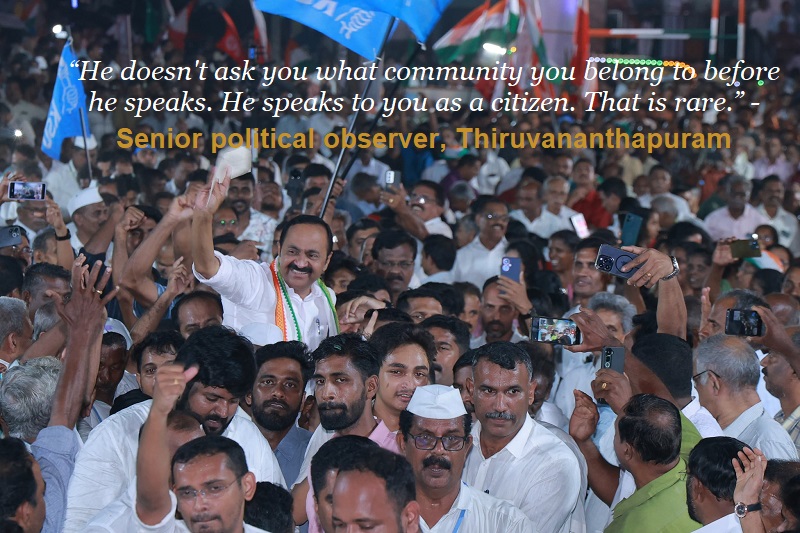
This clarity cut across community lines in ways that surprised even experienced Kerala political analysts. In Thavanur, a Muslim-majority constituency, Congress candidate V.S. Joy won convincingly – voters choosing governance credentials over identity politics. In Kochi, a Christian-majority seat, Mohammed Shiyas of the INC won by over 8,000 votes – a Congress Muslim candidate winning in a Christian-majority urban constituency, because voters prioritised Satheesan’s coalition of values over the mathematics of faith.
His legal background – nearly a decade as an advocate in the Kerala High Court before entering full-time politics – gives his democratic ideology a constitutional rigour. He argues for federalism not as a rhetorical position but as a structural belief: that the relationship between the Union and states should be governed by the spirit of cooperative federalism enshrined in the Constitution, not by the political convenience of the party in power at the Centre. His legislative interventions as Leader of the Opposition were consistently constitutional in their framing – the kind of arguments that hold up not just in an Assembly session but in a court of law.
This Nehruvian clarity also explains his economic vision. He is not anti-market, but he is firmly pro-equity. He believes that Kerala’s famed social development model – high literacy, low infant mortality, high life expectancy – is not an accident or a relic but the product of deliberate, consistent public investment in human capital. His government’s economic agenda will seek to build on this foundation, not replace it.
From Nettoor to Cliff House: A Journey Built on Persistence
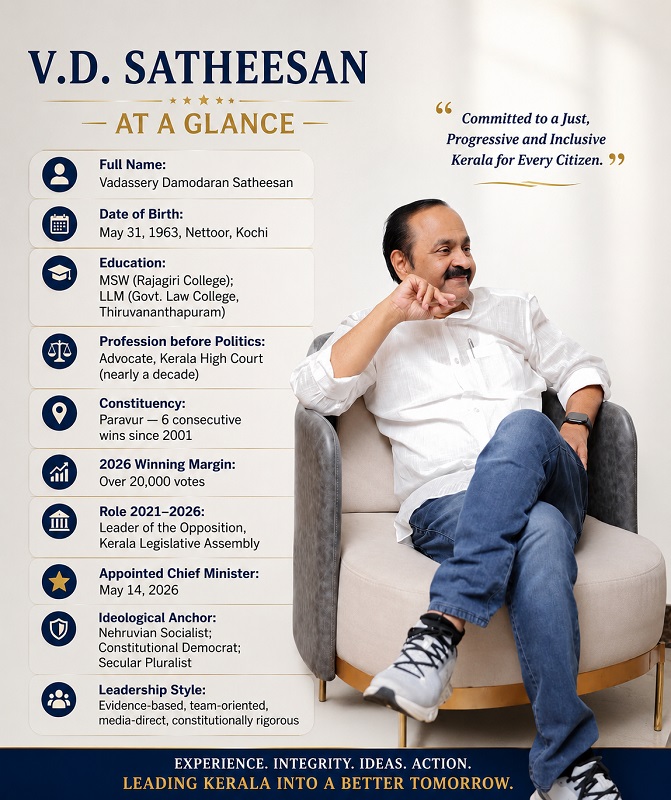
V.D. Satheesan’s biography reads less like the story of a dynasty scion and more like a Kerala version of a classic democratic ascent: the son of a middle-class family from Nettoor near Kochi, who pursued social work and law, took his early political lumps in the crucible of student activism, lost his first election, and built his career ward by ward, constituency by constituency, argument by argument.
Born on May 31, 1963, in Nettoor, Kochi – the son of K. Damodara Menon and V. Vilasini Amma – Satheesan was educated at Sacred Heart College before completing a Master’s in Social Work from Rajagiri College of Social Sciences. He later pursued law at Kerala Law Academy and earned his LLM from Government Law College, Thiruvananthapuram. The combination of social work and law is, perhaps, the most revealing credential of his character: one discipline training him to see the human texture of policy, the other training him to argue for it precisely.
His entry into politics came through the Kerala Students Union, the student wing of the Indian National Congress – a path walked by many of Kerala’s most significant Congress leaders. He served as Chairman of the Mahatma Gandhi University Union in 1986–87. Before transitioning to full-time politics, he spent nearly a decade practising as an advocate in the Kerala High Court – a formative experience that shaped his meticulous, evidence-based approach to political critique.
In 1996, he stood for election from Paravur – then a Left stronghold – and lost. It is the kind of defeat that ends political careers or defines them. For Satheesan, it was the latter. He returned in 2001, won the seat, and has not lost it since. In 2026, he won his sixth consecutive term from Paravur with a margin exceeding 20,000 votes – in a state where even dominant leaders regularly face close contests and occasional upsets. That consistency, in Kerala’s volatile political geography, speaks to something beyond party loyalty: it speaks to genuine personal trust.
Five Years That Built a Revolution: The Opposition Chapter
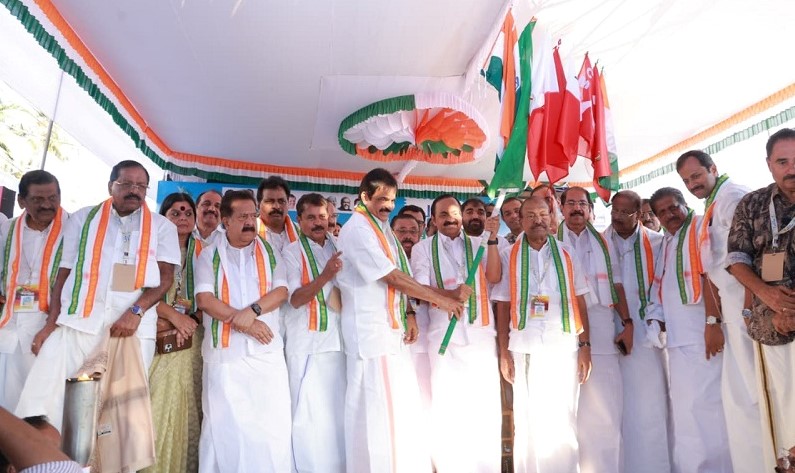
The appointment of V.D. Satheesan as Leader of the Opposition in 2021 was itself a statement of intent by the Congress high command – and a surprise to many within the party. The post went not to a veteran factional heavyweight but to a man who had steadily built credibility through legislative performance and organisational discipline.
The Congress in Kerala at that point was in its most difficult position in decades: organisationally fractured, struggling for urban traction, having just lost an Assembly election it had expected to win, and facing an LDF government riding high on a governance narrative that combined social spending with administrative centralisation. The natural instinct in such a moment is to retrench, to play safe, to wait for the government to fail.
Satheesan chose a different strategy: aggressive, evidence-based, constitutionally framed opposition that forced the government onto the defensive on ground it had considered secure.
THE FIVE PILLARS OF HIS OPPOSITION STRATEGY
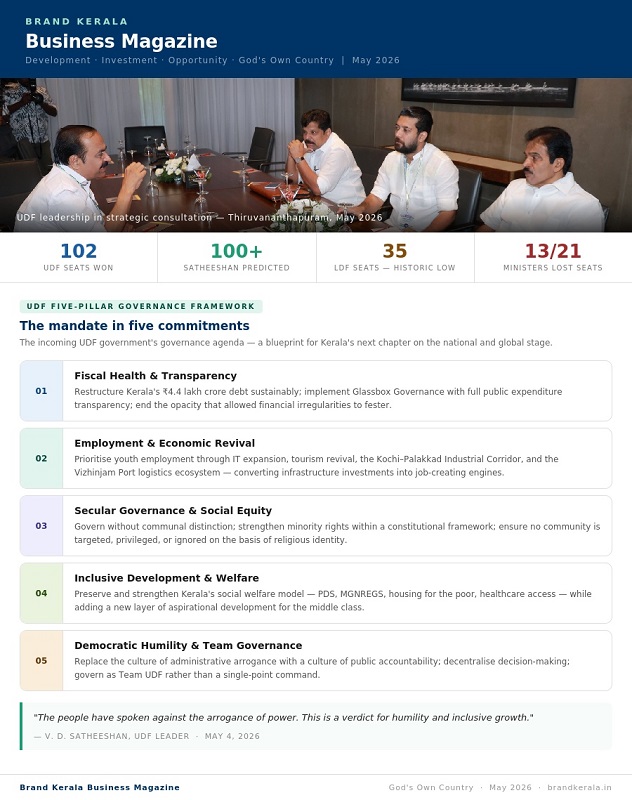
First, he modernised the Opposition itself. He moved away from traditional protest politics – the bandhs, the hartal-era confrontations – toward a model of opposition grounded in data, court proceedings, and media communication. His press conferences were events: detailed, documented, difficult to dismiss.
Second, he built an anti-corruption narrative that was specific, not generic. Rather than simply alleging corruption, he targeted specific episodes with named individuals, documented timelines, and constitutional arguments – the kind of critique that is far more damaging precisely because it is harder to deflect with a counter-slogan.
Third, he invested in organisational revitalisation at the grassroots. The party’s booth-level infrastructure, which had atrophied through years of factional infighting and repeated electoral disappointments, was systematically rebuilt – not through dramatic announcements but through the slow, unglamorous work of re-engaging local workers, holding district-level training sessions, and insisting on candidate accountability.
Fourth, he built the ‘Team UDF’ architecture: a collaborative leadership model that consciously distributed visibility across the UDF coalition rather than concentrating it in a single figure. The IUML’s Sadiq Ali Shihab Thangal was given space to campaign actively in northern Kerala. The Congress’s V.D. Satheesan led the south-central narrative. K.C. Venugopal provided national-level coordination. K. Sudhakaran anchored the KPCC grassroots. The result was a campaign that felt like a coalition of competencies, not a one-man show.
Fifth, and perhaps most consequentially, he began to capture the urban middle-class and young professional vote – a demographic the Congress had been steadily losing to political disillusionment. He did this not with targeted schemes or welfare announcements but with the simple proposition that governance should be transparent, data-driven, and accountable. For a cohort that had grown up watching government opacity with mounting frustration, this proposition was genuinely compelling.
The Five-Point Manifesto: Policy as Politics
In an election season dominated by personality narratives and anti-incumbency sentiment, the UDF’s five-point manifesto agenda was a quietly significant document. It gave the UDF campaign a policy spine that grounded Satheesan’s personal credibility in institutional commitments – and gave voters something concrete to hold the incoming government accountable to.
For Brand Kerala’s readers – investors, entrepreneurs, policy practitioners, and development professionals – the manifesto’s economic planks deserve particular attention. The Vizhinjam Port, now fully operational as a transshipment hub, stands to be a transformative economic asset for the region if the logistical ecosystem around it – road connectivity, cold storage, free trade warehousing – is developed with urgency and coherence. The Kochi-Palakkad Industrial Corridor, if executed with the transparency Satheesan has promised, could position Kerala as a serious player in semiconductor fabrication, precision engineering, and high-value manufacturing. And the tourism revival agenda – including Kerala’s extraordinary natural assets from the Western Ghats to its backwaters and beaches – is, properly leveraged, a multi-billion-dollar economic opportunity.
The new Chief Minister’s government will be judged, ultimately, not just on its political narrative but on its economic delivery. And that is precisely the terrain on which Satheesan, having campaigned on accountability and evidence, has invited the judgment.
What the Satheesan Moment Means for Brand Kerala
For those watching Kerala from the outside – investors, diplomats, tourism planners, development organisations – the 2026 election result carries signals that extend well beyond the partisan arithmetic.
The first signal is about political stability. A government that enters office with 102 seats in a 140-member house has the legislative authority to make difficult decisions – on fiscal consolidation, land policy, regulatory reform, and labour law modernisation – that a thin-majority government cannot. Satheesan will not be hostage to a handful of defectors or coalition partners with contradictory agendas. That structural comfort is an under-appreciated economic asset.
The second signal is about governance philosophy. A leader who built his political credibility on data-driven critique and constitutional arguments is unlikely, in office, to govern by opaque decree. The promise of ‘Glassbox Governance’ is exactly the kind of signal that institutional investors and foreign development partners need to hear: that contracts will be honoured, that regulatory processes will be transparent, that the rules of the game will not change without notice.
The third signal is about Kerala’s generational transition itself. The fact that a new political generation – young, educated, globally connected, ideologically sophisticated – showed up in large numbers for this election and chose the UDF tells us something important about what Kerala’s future workforce, consumer base, and civic society will look like. They are not looking for a welfare state alone; they are looking for a state that can provide them opportunities to build lives here, in Kerala, rather than in Bengaluru or Dubai.
The fourth signal — and perhaps the most significant for Brand Kerala’s purpose of showcasing Kerala on the global stage – is the secular mandate itself. In a world increasingly fractured along religious, ethnic, and civilisational fault lines, a democracy that reaffirms its pluralist, secular foundations through a free and fair election is sending a message of enormous value. It says: Kerala is a place where a Muslim candidate wins a Christian-majority constituency on the strength of governance credentials; where a Congress candidate wins a Left stronghold on the strength of persistent local service; where communities vote across traditional lines because they have decided that their future matters more than their identity politics. That is a brand proposition of extraordinary power.
The Road Ahead: Promise and Pressure
No analysis of this political moment would be complete without acknowledging the weight of the challenges that await the new Chief Minister. Brand Kerala does not deal in hagiography – our purpose is honest, constructive, development-focused analysis. And honest analysis requires acknowledging that Satheesan’s government inherits a difficult situation alongside its commanding mandate.
THE FISCAL MOUNTAIN
Kerala carries a public debt exceeding ₹4.4 lakh crore. The state’s revenue generation, constrained by its geography and economic structure, struggles to keep pace with welfare expenditure, pension liabilities, and infrastructure commitments. The new government’s fiscal consolidation plan will require hard choices – and the communication of those choices to a public that has been promised both reform and welfare continuity.
WELFARE AND GROWTH: THE DEFINING TENSION
Kerala’s social development model is genuinely extraordinary – it is the reason the state’s human development indicators rival those of much wealthier countries. But it requires sustained public investment. Balancing that investment with the fiscal discipline necessary to attract private capital and maintain credit ratings is the central economic tension of Kerala governance, and Satheesan will not escape it. His answer, he has said, is to grow the revenue base – through tourism, industrial expansion, and IT – rather than simply cut expenditure. The proof will be in the execution.
MANAGING THE COALITION
A mandate of 102 seats is comfortable, but the UDF remains a coalition – and coalitions carry their own internal physics. The IUML, the Kerala Congress factions, and the Congress’s own multiple internal streams all have legitimate interests and expectations. Satheesan’s ‘Team UDF’ model was an electoral success; converting it into a governing discipline will require the same organisational patience and political communication skill he demonstrated in opposition.
CENTRE-STATE RELATIONS
The relationship between Thiruvananthapuram and New Delhi will significantly shape Kerala’s access to central funds, infrastructure projects, and investment facilitation. Satheesan’s challenge – managing a productive working relationship with a Central government led by a party his coalition has contested strongly – is a diplomatic and political skill test that will require pragmatism without compromise of principle.
God’s Own Country, New Chapter
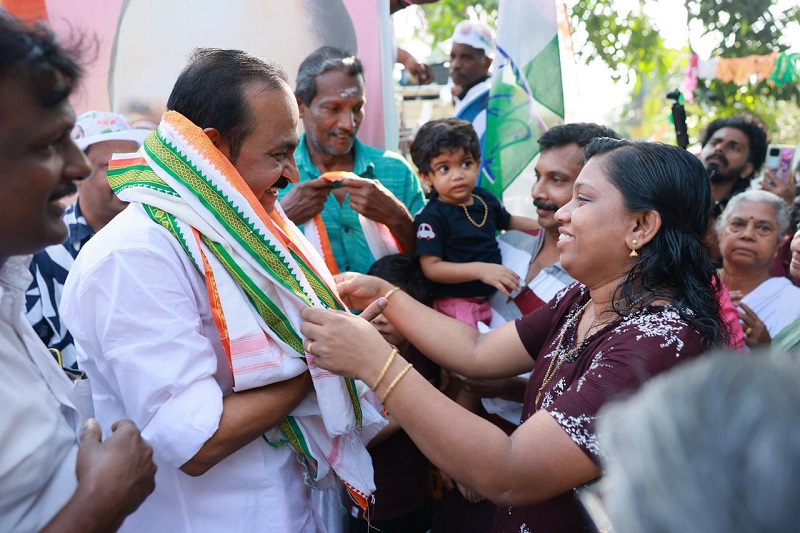
In the long arc of Kerala politics — a state that has given India its highest literacy rates, its most innovative local self-government experiments, its most remarkable social indicators, and some of its finest intellectual and cultural traditions — the Satheesan moment represents something genuinely significant.
It is the arrival, at the apex of power, of a leader shaped not by dynastic inheritance or factional patronage but by the classic ingredients of democratic politics: persistence, conviction, communication, and the hard work of rebuilding an organisation from the ground up. It is the validation, by a young and politically literate electorate, of a style of leadership that treats voters as citizens capable of handling complexity, not as consumers to be managed with simplified messaging.
It is, for those who follow Kerala with the attention it deserves, a moment of considerable hope.
Brand Kerala Business Magazine will follow the Satheesan government’s first 100 days with close attention – tracking its fiscal decisions, its investment policies, its governance reforms, and the progress of its five-point manifesto commitments. Because what happens next in God’s Own Country is not just a Kerala story. In a world looking for examples of democracy that delivers, it is a story the world needs to hear.