

IN CONVERSATION– Minister P.C. Vishnunadh On Kerala’s Historic Budget for Cinema, Culture and Tourism, How the 2026 Budget Is Building a Global Identity Through Three Converging Industries
By Rajani A, Editor
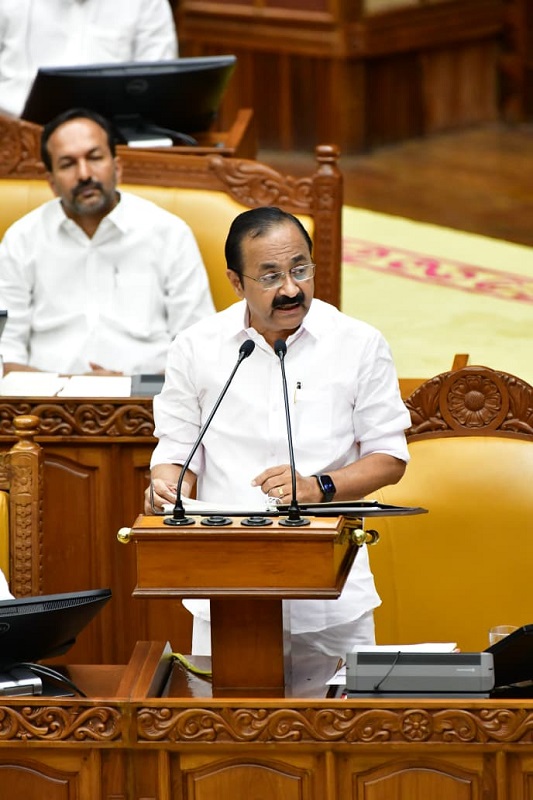
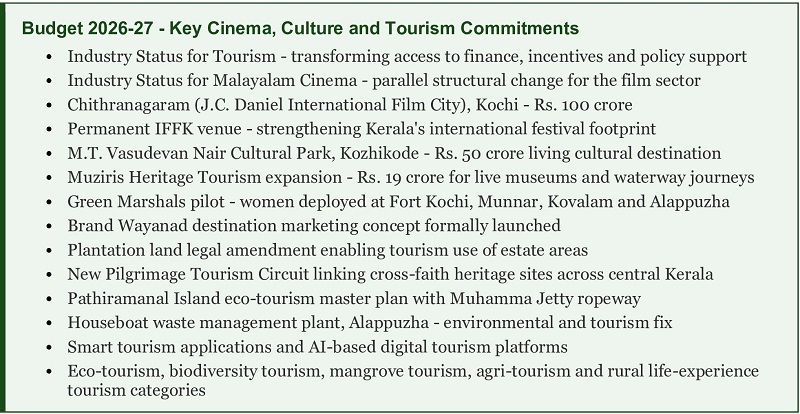
When Brand Kerala Editorial team sat down with Tourism Minister P.C. Vishnunadh in the days following the State Budget presentation, the conversation kept returning to one word: historic. Kerala’s 2026 Budget – presented by Chief Minister V.D. Satheesan – has granted industry status to both tourism and Malayalam cinema in the same Budget cycle, launched a Rs. 100 crore International Film City, committed Rs. 50 crore to a living cultural park honouring M.T. Vasudevan Nair, and unleashed a wave of tourism infrastructure across plantations, pilgrimage circuits, backwaters, and coastal corridors. In a wide-ranging conversation spanning policy, branding, and the long view, the Minister explains why this moment is different – and why the real work is only beginning.
A Long-Pending Demand, Finally Met
It is a word easily overused in political discourse. Historic. But when Kerala’s Tourism Minister P.C. Vishnunadh uses it to describe the 2026 State Budget, he is not resorting to the habitual superlative of press releases. He is pointing to something specific: the extension of industry status to the tourism sector – a demand that Kerala’s hoteliers, tour operators, houseboat owners, and homestay networks have placed before successive governments for over two decades.
Chief Minister V.D. Satheesan acknowledged this gap directly in his Budget speech, stating that the Government would take steps to make tourism a priority sector in Kerala. For Vishnunadh, the announcement carries implications that go well beyond symbolism. “It changes how tourism enterprises access institutional finance, how they are treated in policy terms, and what kind of confidence it gives both existing entrepreneurs and prospective investors,” he explained.
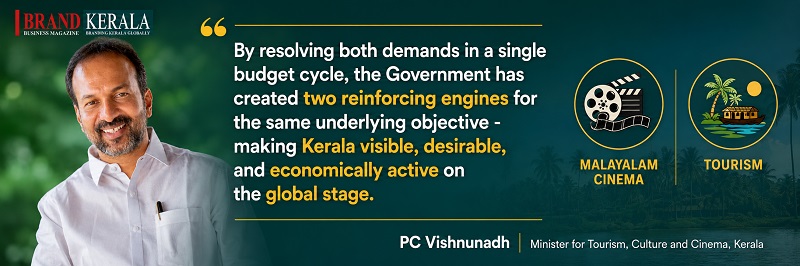
What makes Budget 2026-27 particularly distinctive, however, is that industry status was not granted to tourism alone. In the same Budget cycle, the Government also extended industry status to Malayalam cinema – a parallel and equally long-pending demand from the film fraternity. The symmetry is deliberate. Tourism and cinema are, in branding terms, mirror industries: both rely on visibility, both convert intangible appeal into economic activity, and both have historically struggled to access the institutional financing and policy support available to conventional sectors.
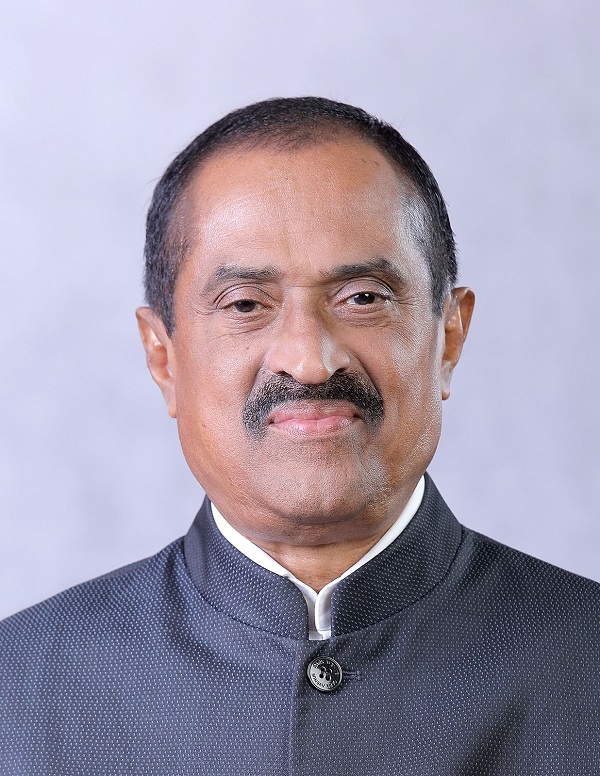
The Confederation of Kerala Tourism Industry (CKTI) has called this a long-standing demand finally met. CKTI President E.M. Najeeb noted that the budget’s emphasis on tourism throughout the Chief Minister’s speech reflects a development policy that treats tourism as a driving force in the state’s comprehensive economic and social progress – one that integrates multiple sectors through coordinated activity. He also flagged the industry’s expectations going forward: stronger inter-departmental coordination, and significantly increased funding for promotional campaigns and marketing at both national and global levels.
Chithranagaram: Building a Cinema-Tourism Feedback Loop
The centrepiece of the cinema announcements is the proposed J.C. Daniel International Film City, to be established in Kochi under the name Chithranagaram – named after the father of Malayalam cinema. Backed by a Rs. 100 crore allocation, the project is envisioned as a modern production hub capable of attracting domestic and international film projects, supported by anti-piracy initiatives and production incentives. Alongside it, the Government has announced a permanent venue for the International Film Festival of Kerala (IFFK), a move expected to strengthen the festival’s international profile and generate cultural activity throughout the year rather than during a single annual window.
The tourism implications of these decisions are substantial, even if indirect. Globally, destinations that feature prominently in film and television productions routinely experience measurable increases in visitor interest. With dedicated film city infrastructure, stronger production facilities, and an internationally anchored festival, Kerala is positioning itself to leverage its cinematic legacy and scenic diversity as deliberate tourism assets – not incidental ones. A landscape that appears in a globally distributed film becomes, almost immediately, a landscape that travellers want to see in person.

The response from the Malayalam film industry has been immediate and prominent. Leading figures including Mammootty, Mohanlal, Prithviraj Sukumaran, and Tovino Thomas have publicly welcomed the decision, with many noting that industry status will improve access to institutional financing, encourage fresh investment, and strengthen the long-term sustainability of the industry. Within the film fraternity, Chithranagaram and the accompanying anti-piracy measures have been described as transformative.
Culture as Infrastructure: The M.T. Vasudevan Nair Cultural Park
If cinema represents Kerala’s most contemporary cultural export, culture represents its deepest reservoir of authenticity – and Budget 2026-27 treats it accordingly. The proposed M.T. Vasudevan Nair Cultural Park in Kozhikode, backed by Rs. 50 crore and named after the Jnanpith award-winning literary legend, is arguably the most ambitious cultural tourism project Kerala has announced in recent years.
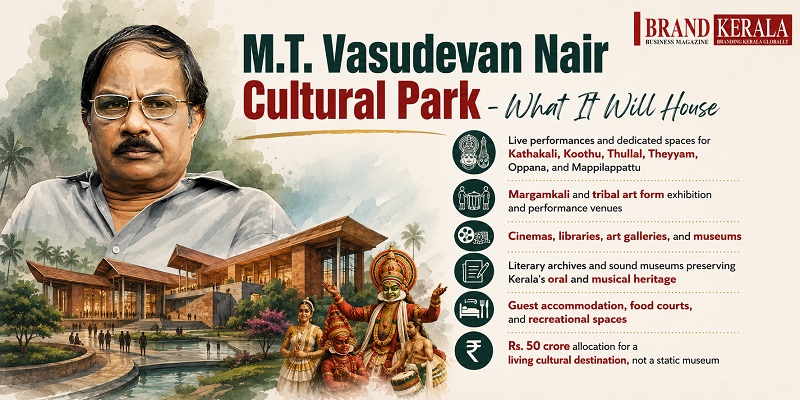
This is significant because it reframes culture as tourism infrastructure in the same category as roads, terminals, or airports – something to be invested in, maintained, and experienced, rather than simply preserved. Supporting allocations extend this logic: Rs. 5 crore for the Johnson Master Music Academy in Thrissur, Rs. 1 crore for a memorial to actor Salim Kumar, Rs. 1 crore for the Umbayi Music Academy, Rs. 10 crore for the renovation of Thekkinkadu Maidanam, and Rs. 5 crore for Sivagiri’s international convention centre. Individually modest, collectively they signal a state methodically building out the cultural layer of its tourism product.
For the modern traveller, this matters more than it might have a decade ago. Global travel patterns increasingly favour authentic cultural immersion over conventional sightseeing. By investing simultaneously in cinema, music, literature, and traditional art forms, Kerala is constructing tourism products capable of attracting visitors across multiple interest categories, year-round, rather than depending on seasonal backwater or hill-station traffic alone.

What stood out most in conversation with the Minister was how geographically distributed the budget’s tourism vision is. Rather than concentrating investment in a handful of marquee destinations, the announcements stretch from the hill estates of the Western Ghats to the backwaters of Alappuzha and the temple towns of central Kerala.
Plantation Tourism
Perhaps the most structurally significant new announcement is the legal amendment permitting unused land in plantation areas – coffee, cardamom, and tea estates – to be used for tourism-related activities. For a state where plantation tourism has remained constrained by land-use regulation for decades, this is a notable departure.
Vishnunadh frames it as recognition of an opportunity that has long existed but lacked a regulatory pathway. “These plantation landscapes are some of Kerala’s most distinctive assets. Enabling tourism use within them, responsibly, opens a category of experience that visitors are increasingly seeking,” he said. CKTI Organising Secretary Ravisankar K.V. noted that the combination of eco-friendly projects and the plantation land amendment is expected to give particular momentum to the green tourism sector, with Wayanad, Idukki,Pathanamthitta, and Palakkad districts positioned for heightened global visibility.
Backwaters: Renovation and Repair

Few issues in Kerala tourism have generated as much sustained public debate as the state of the Alappuzha backwaters – both their tourism potential and their environmental vulnerability. Budget 2026-27 addresses both sides simultaneously. Tourism amenity centres and houseboat terminals built under the Central Government-assisted Mega Tourism Circuit Project will be renovated and brought back into effective use.
More significantly, a dedicated waste management plant for houseboat waste will be established in Alappuzha – addressing a longstanding environmental demand tied to persistent concerns over pollution levels in Vembanad Lake. “This is not just a tourism infrastructure decision, it is an environmental commitment,” Vishnunadh noted.
A New Pilgrimage Circuit
The budget introduces a new Pilgrimage Tourism Circuit, linking Arthunkal Basilica, Ambalappuzha Temple, Kakkazham Church, Mannarasala, Krishnapuram Palace, Mata Amritanandamayi Math, and Ochira Temple. The deliberate mix of Christian, Hindu, and spiritual destinations signals an intent to position pilgrimage tourism as a connective thread across Kerala’s religious and cultural diversity. For a state that has historically under-marketed its pilgrimage assets relative to its backwaters and hill stations, the Minister describes this as filling a meaningful gap in Kerala’s tourism portfolio – and reaching a category of traveller who has thus far been largely unaddressed.
Muziris and Maritime Heritage
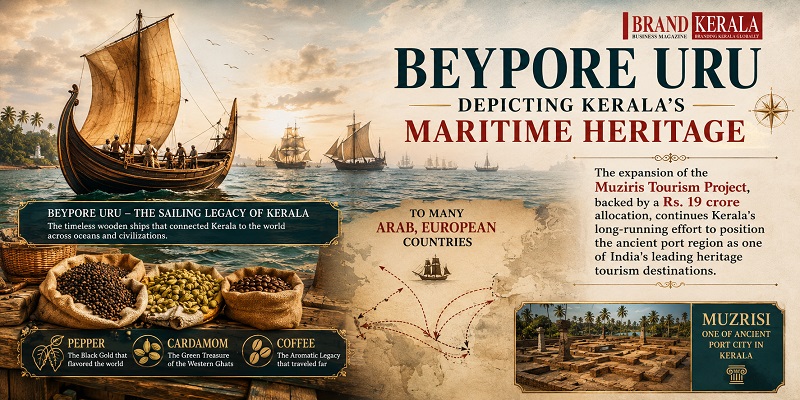
The expansion of the Muziris Tourism Project, backed by a Rs. 19 crore allocation, continues Kerala’s long-running effort to position the ancient port region as one of India’s leading heritage tourism destinations. The plan includes live museums, heritage museum spaces, and traditional waterway boat journeys – combining preservation with experiential tourism in a model the Minister describes as central to Kerala’s broader heritage strategy. Brand Wayanad is also formally introduced as a distinct destination-marketing concept, alongside dedicated initiatives to promote Ashtamudi tourism – both signalling an intent to build stronger, more differentiated regional identities beyond the familiar Kerala monolith.
Green Marshals: Women at the Forefront of Kerala’s Tourism Economy
One of the more socially significant announcements is the pilot Green Marshals project, to be launched at Fort Kochi, Munnar, Kovalam, and Alappuzha. Under this initiative, women will be trained and deployed to promote cleanliness, responsible visitor behaviour, and environmental awareness at these high-footfall destinations.

The Green Marshals initiative sits within a broader philosophy that runs through much of the budget’s tourism architecture: community-based and women-led tourism models as drivers of both economic and social change. Community-based tourism hubs and cultural tourism hubs are planned to create employment while preserving Kerala’s traditions, food culture, and heritage. Women-led tourism enterprises, homestays, and responsible tourism projects are set to be expanded across the state – continuing and scaling models that have already shown success in pockets of Kerala’s tourism economy.
Maritime Ambition, Aviation Connectivity and the Green Tourism Frontier
CKTI Organising Secretary Ravisankar K.V. described the budget’s tourism announcements as visionary, drawing particular attention to a cluster of aviation and maritime initiatives: comprehensive aviation travel and entrepreneurial opportunities built around Kerala’s four international airports, a strong maritime development focus, the introduction of hydrofoil transport systems, and a deliberate push to transform the state into a cruise tourism hub.
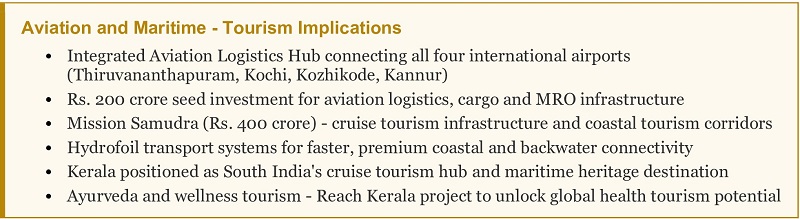
CKTI General Secretary Sajeev Kurup, who also serves as President of the Kerala Ayurveda Promotion Society, highlighted the announcement of the Reach Kerala project as a measure with the potential to give renewed momentum to Ayurveda and wellness tourism – positioning Kerala as a potential top global health tourism destination. He also welcomed plans to revive Wayanad tourism and sustain Munnar’s tourism economy.
Taken together, the aviation and maritime announcements point toward an ambition that extends well beyond conventional tourism marketing – toward positioning Kerala as a logistics and connectivity hub for the wider South Indian and Indian Ocean region, where tourism is one strand of a much larger strategic weave.
The Brand Architecture Taking Shape
Read in full, Budget 2026-27 is not three separate sectoral announcements. It is a single coherent strategy in which cinema, culture, and tourism operate as mutually reinforcing forces. Cinema generates global visibility and emotional association. Culture supplies authenticity, depth, and a reason for that attention to translate into a desire to visit. Tourism provides the infrastructure, connectivity, and experience design to convert that desire into sustained economic activity.
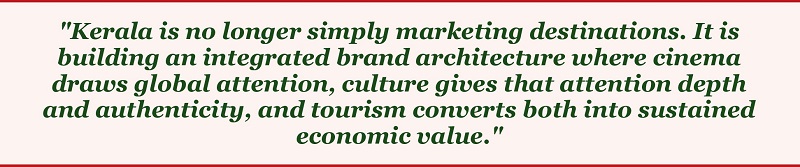
Kerala is no longer simply marketing destinations; it is building an integrated brand architecture where cinema draws global attention, culture gives that attention depth and authenticity, and tourism converts both into sustained economic value. For a state whose international image has long rested on a handful of familiar markers – backwaters, Ayurveda, and the God’s Own Country tagline – this budget signals an evolution of considerable ambition.
A Foundation, Not a Finish Line
Asked to characterise the long-term implications of the budget, Minister Vishnunadh was careful to frame this as a beginning rather than a culmination. “These announcements address several long-pending demands of the tourism sector, but the real test is implementation – across plantations, pilgrimage circuits, backwaters, and women-led enterprises alike,” he said.
For an industry that has waited years for formal industry recognition, and a state whose tourism brand has long rested on a handful of iconic destinations, Budget 2026-27 represents an attempt to broaden that base – geographically, socially, and economically. Whether it succeeds will depend on the pace and rigour of implementation in the months ahead.
But the architecture is sound. The ambition is clear. And for the first time in a long time, Kerala’s cinema industry, its cultural institutions, and its tourism sector are being asked to pull in the same direction – toward a single, globally recognisable Brand Kerala that can compete not just regionally but on the world stage.